Saturday, 18 December 2010

A Venetian Christmas

First Mass of Christmas as it may have been celebrated at St Mark’s, Venice around 1600
Music by Giovanni Gabrieli and Cipriano de Rore
Gabrieli Consort & Players
conducted by Paul McCreesh
DG Archiv, released October 2001

Kyrie from the Missa Praeter rerum seriem by Cipriano de Rore:


For the Doge and the Venetian nobility, Christmas Eve heralded a sequence of attendances in the Basilica which were celebrated with the greatest solemnity and ceremonial. The 16th century Venetian historian Francesco Sansovino refers to these andate (processions of state) for which the chapels surrounding the High Altar of San Marco were filled with benches and chairs to accommodate the throng of dignitaries.

At about 14.30 (two hours before sunset), the Doge and the Signoria – a privileged group of his closest political advisers – came down from the Ducal Palace into San Marco itself, where they heard Vespers, celebrated by the musicians of the regular choir, augmented for the occasion by other singers and instrumentalists. Sansovino records that “the musical settings – in eight, ten, twelve and sixteen parts – stupefied and amazed the members of the congregation, and in particular those from beyond the city, who confessed to having heard no finer music in many parts of the world”.

After Vespers, Compline was said , and this in turn was followed immediately by sung Matins set to a format peculiar to the San Marco liturgy. As soon as Matins had concluded – at about 18.30 (two hours after sunset) – the first Mass of Christmas began, the normal obligation to wait until midnight having been removed by a special concession granted to the Venetian Republic by the Pope.

The Office of Matins began in total darkness, but towards the end of the service San Marco was illuminated by the progressive lighting, with a linen wad, of 1500 candles each weighing 400 g. and 60 candles each weighing 5 kg. which were placed around the basilica as high as one could see, almost eclipsing the light of the silver oil-lamps and other candles, both large and small, which were positioned above and beside the High Altar. Sansovino describes the effect as “an illumination brighter than one might see at midday, which astonishes everyone standing to admire the number and density of the candles... one could not see grander, richer, more splendid, more noble or more illustrious illuminations not only in the whole of Italy, but also in the whole of Christendom”.

In this breathtaking setting, the Doge, himself resplendent in the insignia of his office, left his throne, and accompanied by the papal Legate and his Orators, knelt on the first step in front of the High Altar to reply to the Confession made by the Legate. This distinctively Venitian symbiosis of religion, political control and acute sense of tradition and history is epitomized in the motet Audite principes which appears to speak directly to the assembled members of the oligarchy of the Serenissima – the most Serene Republic (many in the congregation would have identified with the phrases ‘O most serene princes... O most reverend elders... O most excellent forefathers’). The musical style complements the ambience, with the three groups, each comprising a declamatory solo voice with varied supporting instruments, soon combining in a grandiloquent 16-part tutti. Giovanni Gabrieli’s characteristic compositional metaphors exploit the basilica’s resonant acoustic, with juxtapositions of harmonies a third apart, extended progressions by cycles of fifths, and a sudden swerve at the word mirabilia on to an E flat triad to illustrate the unexpected marvel of the birth of Jesus.

Friday, 17 December 2010

Palazzo Farnese Exhibition

Palazzo Farnese - From the Renaissance to the French Embassy
Palazzo Farnese, Rome
17th December 2010 to 27th April 2011

A collection of 150 works (drawings, sculptures, paintings, art objects) which brings to life the history of the Palace through five centuries.

The Farnese Palace, splendour of the Farnese family in the sixteenth century, and for the last 135 years the home of the French Embassy in Rome and of the Ecole Française de Rome. An important selection of works from the Farnese collection returns to the place where it was assembled thanks to the passion for art of the Farnese family.

Palazzo Farnese, Rome
The exhibition Palazzo Farnese - From the Renaissance to the French Embassy was conceived by Jean-Marc de La Sabliere, French Ambassador to Italy. It is produced in collaboration with the Italian Ministry of Culture. The curators are Francesco Buranelli, Secretary of the Pontifical Commission for Cultural Heritage of the Church, and Roberto Cecchi, Secretary-General of the Italian Ministry of Culture.

For this exhibition, the Palace will be open by reservation only, and will welcome the return of the Museum Farnesianum; the Hall of the Emperors and the Hall of the Philosophers will be recreated and, for the occasion, the famous Dacian prisoners will resume their place alongside the porphyry statue of Apollo, known at the time as Roma Triumphans.

The French Ambassador to Italy, Jean-Marc de La Sabliere, shows some of the treasures of the Palazzo Farnese (in French):


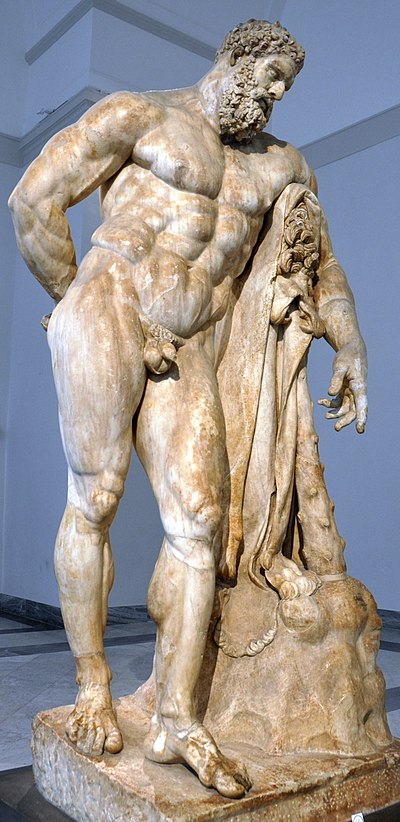
Farnese Hercules
Roman copy of a lost original by Lysippus
Museo Archeologico Nazionale, Naples
 Thanks to new technology, the courtyard will be virtually occupied by the imposing silhouettes of the Farnese Atlas, the Farnese Hercules and the Farnese Bull. Generous loans from the magnificent collection of the National Archaeological Museum of Naples have enabled the return of these works.

Among the most notable furniture, the worktable from the Museum of Ecouen, designed to hold the Farnese's collection of coins and cameos. Tapestries from the Quirinal, lent by the President of the Italian Republic, and from Chambord Castle, as well as Renaissance ceramics, retake their place in the salons of the main floor.

The portrait of Pope Paul III by Titian, Christ and the Canaanite woman painted by Annibale Carracci for the private chapel of Cardinal Odoardo, works by Sebastiano del Piombo, Carracci and El Greco testify to the rich collection of paintings newly exhibited in the northeast gallery. The collection of preparatory drawings by Annibale Carracci (from, inter alia, the Louvre) and frescoes from the Palazzo Fava in Bologna illustrate the design of the famous fresco cycle The loves of the Gods by Carracci. Most of the paintings mentioned are from the Capodimonte Museum of Naples, and from museums in Parma and Bologna.

Annibale Carracci, The Triumph of Bacchus and Ariadne (1595)
Palazzo Farnese, Rome
The exhibition aims to revive the intertwined stories of Popes, cardinals, kings, ambassadors and artists who, for five centuries, met and lived in the Farnese Palace, contributing to making it an exceptional and vibrant place.

The Palazzo Farnese was commissioned by Alessandro Farnese (1468-1549), who in 1534 became Pope Paul III. Begun in 1514 by Antonio da Sangallo the Younger, the construction of the Palace continued under the direction of Michelangelo (1546-1549), then Vignola and Giacomo della Porta, who completed it in 1589.

Domenichino, Virgin and a Unicorn (1602)
Palazzo Farnese, Rome
The Cardinals Ranuccio, Eduardo and Alessandro Farnese, Paul III's descendants, entrusted to the greatest artists of the time the painted decoration of the ceremonial rooms: Towards 1560, the grand salon of the Fasti; around 1600, the Camerino, then the Carracci gallery. The remarkable Farnese collection of sculptures, paintings, art objects and books continued to expand.

Towards the middle of the seventeenth century, the interests of the Farnese family moved from Rome to Parma, then the family died out and its possessions passed in the first half of the eighteenth century to the Bourbons of Naples, to where the complete Farnese collection was transferred.

Report on the exhibition by Inside Art Italia (in Italian):
 

Tiziano Vecellio (Titian), Pope Paul III (1545)
Museo Nazionale di Capodimonte, Naples
Ambassadors of France resided in the Farnese Palace from the sixteenth century through the seventeenth and eighteenth, but only in 1874 was the Embassy established there permanently, followed in 1875 by the Ecole Française de Rome. Purchased by the French state then sold back to Italy, the Palace has been governed since 1936 by a 99-year lease covering the two embassies, Italian and French, in Paris and in Rome.


Official exhibition page (in Italian and French only)
Palazzo Farnese Wikipedia page

Farnese Atlas
Museo Archeologico Nazionale, Naples
Bacchus
Palazzo Farnese, Rome
Sebastiano del Piombo, Portrait of Pope Clement VII
Museo Nazionale di Capodimonte, Naples
Jean Ranc, Portrait of Elisabeta Farnese
Museo del Prado, Madrid
Pierre Adrien Paris, A view of the entrance to the Great Hall, Palazzo Farnese
Bibliothèque Municipale, Besançon
Seated Apollo (Roma Triumphans)
Museo Archeologico Nazionale, Naples
Squatting Venus with Cupid
Museo Archeologico Nazionale, Naples
Venus Callipygia
Museo Archeolgico Nazionale, Naples

Thursday, 16 December 2010

Angelika Kirchschlager - Sounds Like Christmas

Sounds Like Christmas
Angelika Kirchschlager - soprano
Ensemble Amarcord
Freiburg Baroque Orchestra
dir: Gottfried van der Goltz
Label: EuroArts
released October 2004
Running time: 82'

This Christmas DVD presents the soprano Angelika Kirchschlager. Recorded live in the picturesque gothic Cistercian monastery of Schulpforta in Saxony-Anhalt, the concert footage is combined with charming motifs of snowy mountain landscapes and cities decorated for Christmas. Favourite Christmas compositions from the classical repertoire are combined with popular carols – and it all sounds like Christmas! Angelika Kirchschlager currently ranks among the most sought-after sopranos worldwide for both opera and concert-hall performance She is accompanied by the outstanding Freiburg Baroque Orchestra. The Leipzig a-cappella ensemble Amarcord, former members of St. Thomas’s Boys Choir, sing popular Christmas tunes.

Pforta, or Schulpforta, is a former Cistercian monastery, Pforta Abbey (1137-1540), near Naumburg on the Saale River in the German state of Saxony-Anhalt. It is now a celebrated German public boarding school, called Landesschule Pforta. The remains of the monastery include the 13th century gothic church; it is a cross-vaulted, colonnaded basilica with an extraordinarily long nave, a peculiar western façade, and a late Romanesque double-naved cloister. What remains of the original building (1137–40) is in the Romanesque style, while the restoration (1251–1268) belongs to the early Gothic. Other buildings are now used as dormitories and lecture halls. There is also the Fürstenhaus (Prince's house), built in 1573. Schulpforta was one of the three Fürstenschulen (Prince's schools) founded in 1543 by Maurice, Elector of Saxony (at that time Duke). Notable former pupils include Friedrich Gottlieb Klopstock, Johann Gottlieb Fichte, August Ferdinand Möbius, and, from 1858 to 1864, Friedrich Wilhelm Nietzsche!

Extracts:


Wednesday, 15 December 2010

Cranach - The Other Renaissance

Lucas Cranach the Elder (1475-1553)
Venus and Cupid with a Honeycomb
Galleria Borghese, Rome
Lucas Cranach - The Other Renaissance
Galleria Borghese, Rome
15th October 2010 - 13th February 2011

The Borghese Gallery in Rome presents 45 of Cranach's most significant works from leading European and American collections. The exhibition investigates a still-open question, the relationship between Cranach and the art of the Italian Renaissance of the period.

Lucas Cranach the Elder was, along with Albrecht Dürer, the leading figure of the rebirth of German painting around 1500.The exhibition aims to present a comprehensive view of the Renaissance painter, court artist and innovator, linked with the Flemish tradition but influenced also by the new developments in Italian figurative painting.

In art history, Cranach is perhaps best known as a friend and supporter of Luther, with whom he laid the foundations for a Protestant iconography. But Cranach, in charge of a large and very active studio in the city of Wittenberg, also introduced other subjects into painting, in particular a new imagery of the nude and the erotic, as well as Humanist themes and a particularly effective and innovative style of portraiture. Cranach was the exponent of 'another' Renaissance, different from the classical theories and practice of his great contemporary and rival Albrecht Dürer; different also from the Italian Renaissance; a court artist, but an innovative one, who developed a new and visually attractive formal language.

Lucas Cranach. The other Renaissance is curated by Prof. Bernard Aikema, an art historian and one of the leading authorities on the German artist, and Anna Coliva, Director of the Galleria Borghese.

Feature on the exhibition by Rome Reports, including short interview with curator Bernard Aikema


Lucas Cranach, The Golden Age
Alte Pinakothek, Munich
Court painter:
In 1504 Lucas Cranach obtained the position of official painter at the court of the Elector of Saxony, Frederick the Wise, succeeding the Venetian Jacopo de'Barbari. Aged only 32, and after an initial period of activity still obscure to his biographers  (the painter lived in Vienna before being appointed to the Saxon court), Cranach was awarded this more prominent role in which he would become a painter of importance in the ambience of one of the most important political, cultural and religious courts in Central and Eastern Europe. The seat of the elector of Saxony, of the Holy Roman Empire of the Germanic Nation, was a fashionable cultural centre; the same court where the great painter from Nuremberg, Albrecht Dürer, had been employed on two seperate occasions. Cranach's employment with the Saxon princes lasted for almost fifty years, ending only on his death in 1553. A prolific and successful career which afforded him, along with the protection of his patrons, all the privileges and rewards that follow: in addition to a fixed annual salary - a hundred florins - a choice of residence in the city, even the provision of clothes for himself and his assistants, the opportunity to work for other private clients, and from 1508, the right, not at all common, to an emblem, a winged serpent, which appears in some of his paintings.
Lucas Cranach, Melancholy
Statens Museum for Kunst, Copenhagen
He assumed the role of arbiter of taste and of the propaganda requirements of the Wettin dynasty, for which he executed a very wide range of works, from portraits of courtiers to mythological and religious paintings, hunting scenes, the painted decoration of the halls of Saxon castle but also the design of temporary structures for parties and parades of the court, the supply of designs for medals and banners, the decoration of furniture. He became a model in every field of reference for German and Northern European artists. The role of court artist, and his loyalty to the rulers of Saxony, also earned him diplomatic assignments, such as the journey made in 1508 to Flemish Burgundy with Archduchess Margaret of Austria, an experience crucial to his artistic development. And once more the now aging painter was asked to meet with the Emperor Charles V after the Battle of Mühlberg (1547), during which Prince John Frederick was taken prisoner, and who took him into exile with him in Augusta.
Lucas Cranach, Diana and Actaeon
Galleria Nazionale d'Arte Antica, Trieste
Lucas Cranach, The Garden of Eden
Gemaeldegalerie Alte Meister, Dresden